
Plus Size Jeans: The Most Flattering Cuts for Real Bodies
The most flattering jeans aren't determined by your dress size. They're the jeans that work with your proportions, sit comfortably at the waist, give you enough room through the hips and thighs, and create the silhouette you want. Straight leg jeans are wonderfully versatile, bootcut and flare jeans can balance curvier hips, and wide leg jeans create an easy, elongated line. A higher rise can define the waist, while stretch denim often makes everyday movement more comfortable. Above all, look at rise, waistband, hip fit, thigh fit, leg shape and fabric rather than assuming there's one "correct" cut for a plus size body.
There is a peculiar thing about jeans.
Two pairs can have the same size printed on the label, look almost identical folded on a shelf, and feel completely different the moment you put them on.
One fits beautifully at the hips but leaves a waistband gap. Another hugs the waist perfectly but feels restrictive through fuller thighs. A third technically fits everywhere, yet somehow doesn't create the balanced silhouette you were hoping for.
That's why finding the best plus size jeans isn't really about finding a magic size or following a rigid list of rules. It's about understanding how denim interacts with an actual body: waist, stomach, hips, thighs, leg length and all.
And actual bodies rarely follow a neat template.
Whether you're shopping specifically for plus size jeans, building a broader wardrobe of plus size clothing and apparel, or simply wondering why one jean cut works better than another, understanding fit and proportion can make shopping much easier.
What Actually Makes Plus Size Jeans Flattering?
Let's get one thing out of the way first: "flattering" does not have to mean "makes you look smaller."
It can mean balanced, comfortable, proportioned, sculpted, elongated, waist-defining, relaxed or simply fantastic on you.
That distinction matters.
For years, advice about jeans for plus size women often revolved around disguising parts of the body. Dark washes. Nothing too wide. Nothing too tight. Avoid this if you have hips. Avoid that if you have a tummy.
Real bodies are far more interesting than those rules allow.
A better way to judge a flattering fit is to ask what the jeans are actually doing.
- Does the waistband sit securely without digging in?
- Is there enough room through the hips and thighs?
- Does the denim move comfortably when you sit and walk?
- Does the rise work with your natural waist?
- Is the leg shape creating the proportion you want?
- Does the fabric recover after stretching?
- Do you like what you see when you turn sideways as well as straight on?
- Most importantly, do you actually feel comfortable wearing them?
A pair of curve-friendly jeans should work with your proportions rather than asking your proportions to accommodate the jeans.
Fit the widest point first
One of the most useful principles when shopping for curvy jeans is to pay attention to where your body needs the most room.
For many curvier figures, that's the hips, seat or thighs.
If jeans fit the waist but pull sharply across the hips, form horizontal tension lines or feel uncomfortable when sitting, the cut may simply not provide enough room in those areas. Going up a size can sometimes solve the problem, but it can also create waist gaping.
That familiar combination — a smaller waist with comparatively fuller hips and thighs — is exactly why waistband construction matters so much.
A contoured waistband, well-designed stretch fabric or a cut created with a greater waist-to-hip difference can provide a more natural fit through both areas. The aim is simple: room where you need room and support where you want support.
A useful denim rule: Don't judge jeans solely by whether you can fasten the button. Judge them by how the waist, hips, seat and thighs fit together.
Rise Matters More Than You Might Think
Jean shopping tends to focus heavily on leg shape: skinny, straight, bootcut, wide, flare.
But before we get to any of those, look upwards.
The rise — essentially where the jeans sit between the crotch and waistband — can completely alter both comfort and proportion.
High waisted jeans
High waisted jeans sit at or around the natural waist and can create a strongly defined middle. On curvier figures, that can produce a beautifully structured silhouette, particularly when the waistband fits closely rather than standing away from the back.
A high-rise waist can also visually lengthen the lower half of the body because the perceived starting point of the legs moves upwards.
This makes high rise jeans particularly useful if your goal is:
- defining your waist;
- creating the appearance of longer legs;
- providing more coverage through the stomach;
- pairing jeans with tucked-in tops or shorter layers; or
- creating a more sculpted silhouette.
That doesn't mean every high-waisted fit will automatically be comfortable. If the waistband is too rigid, too narrow or simply the wrong shape, a high rise can dig in when sitting.
Fabric and construction still matter.
Mid rise jeans
A mid rise tends to sit below the natural waist while still providing more coverage than a traditional low-rise jean.
For many people, it's the denim equivalent of the middle ground: enough structure to feel secure, but without the higher waistband of high waisted jeans.
Mid rise jeans can be particularly useful if you have a shorter torso or find that high-rise styles sit too high on your body. Remember, "high rise" and "mid rise" describe the garment — but where that waistband actually lands depends on your proportions.
And low rise?
Low rise jeans have returned to fashion, but they're not compulsory simply because they're trending.
If you love them, wear them.
If you don't, don't.
The more useful question is whether the rise gives you the silhouette and comfort you want. For some bodies, a lower rise creates exactly the relaxed look they're after. For others, a mid or high-waisted fit feels more secure and sits more naturally.
Your body shape doesn't disqualify you from a rise. Your preferences determine whether it belongs in your wardrobe.
Straight Leg Jeans: The Dependable All-Rounder
If there is one cut worth trying when you aren't sure where to begin, it's the straight leg jean.
The clue is in the name. Rather than closely following the leg all the way from thigh to ankle, a straight leg cut maintains a more consistent line downwards.
The result can be remarkably versatile.
On curvy figures, straight leg jeans can skim the thighs without dramatically tapering towards the ankle. That straighter vertical line can create an elongating silhouette while still allowing the natural shape of the hips to show.
They're also easy to style.
A clean straight leg works with trainers and a T-shirt for a casual denim outfit, but change the shoes and add a more structured top or jacket and the same jeans can move comfortably into smart-casual territory.
Who should try straight leg jeans?
Almost anyone.
They can be especially appealing if you:
- want something less fitted than skinny jeans;
- don't want the volume of a wide leg;
- have fuller thighs and prefer a little more room lower down the leg;
- want a timeless silhouette rather than a strongly trend-led cut;
- like jeans that work with several different shoe styles.
For a more leg-lengthening effect, try a high-rise straight leg with a hem that finishes cleanly rather than bunching excessively around the ankle.
If you're petite, pay particularly close attention to the inseam. The perfect fit through the waist and hips can lose its effect if several inches of denim are pooling at the foot.
That doesn't mean petite plus size jeans need to be skinny or cropped. It simply means leg length is part of fit, just as much as waist and hip measurements are.
Wide Leg Jeans: Yes, Curves Can Wear Volume
"Can plus size women wear wide leg jeans?"
Absolutely.
In fact, a wide leg fit can create one of the most striking silhouettes on a curvier figure.
The idea that a larger body must always wear narrow clothes to appear smaller misunderstands how proportions work. Adding controlled volume at the leg can actually balance fuller hips and create a long, uninterrupted vertical line.
The key word there is controlled.
There is a difference between a beautifully draped wide leg and jeans that simply feel several sizes too large.
Look for a pair that fits properly through the waist and seat before falling into a wider leg. That contrast — fitted above, fluid below — gives the shape intention.
Why wide leg jeans can work so well
A good pair can:
- balance curvier hips;
- skim rather than cling to fuller thighs;
- create movement through the leg;
- make a fitted or tucked-in top feel more proportionate;
- produce a dramatic, leg-lengthening line when worn at the right length.
Fabric changes the effect considerably.
Structured denim gives wide leg jeans a stronger architectural shape. Softer denim creates more drape and movement. Stretch denim may feel easier for everyday wear, particularly through the waist, hips and seat.
Neither is automatically better.
They're simply different.
And that brings us to one of the biggest secrets behind finding flattering plus size denim: the cut is only half the story. What the denim is made from can completely change how that cut behaves on your body.
Stretch Denim vs Rigid Denim: The Fabric Changes the Fit
Two pairs of jeans can share the same rise, leg shape and labelled size and still behave very differently.
Often, the reason is the fabric.
Stretch denim contains fibres that allow the material to flex as you move. Depending on the construction, this can make jeans feel softer through the waist, hips and thighs and give them greater ease of movement when sitting, bending or walking.
For curvier figures, that flexibility can be particularly useful. Jeans need to accommodate several dimensions at once, and a little denim stretch can help the fabric follow those curves rather than pulling against them.
But more stretch isn't automatically better.
Very soft stretch fabric can feel wonderful when you first put it on but gradually loosen through the day. This is where fabric recovery and shape retention become important. Good stretch denim should have enough flexibility to move with you while still returning towards its original shape.
Otherwise, the perfect fit at 9 a.m. can become a rather different pair of jeans by 4 p.m.
What about rigid denim?
Rigid or non-stretch denim creates a different look.
Because it doesn't mould and flex in quite the same way, structured denim can create a crisp, defined silhouette. It often feels firmer initially and may require more attention to the fit through your waist, hips and thighs.
That structure is part of its appeal.
If you love vintage-inspired denim, a strong straight leg, structured wide leg or classic mom jean, rigid denim can create a shape that very soft fabric struggles to replicate.
Neither fabric type wins outright.
Think instead about what you want from your jeans:
| If you want... | Consider... |
|---|---|
| More flexibility | Stretch denim |
| A structured silhouette | Rigid denim |
| Easier everyday movement | Soft stretch denim |
| A vintage denim feel | Non-stretch denim |
| Jeans that hug curves closely | Stretch fabric with good recovery |
| A crisp straight or wide leg | More structured denim |
For comfortable denim, don't look at stretch percentage alone. Consider how the entire garment behaves.
Does it pull across the thighs when you sit? Does the waistband roll? Does the seat become loose after a few hours? Does the fabric spring back after being stretched?
The best fabric is the one that keeps doing its job after you've left the fitting room.
Bootcut Jeans: A Clever Way to Balance Proportions
Bootcut jeans deserve considerably more attention than they sometimes receive.
They're fitted through the upper leg before widening gently from around the knee towards the hem. That subtle flare can make a surprisingly large difference to overall body proportions.
For someone with wider hips or fuller thighs, the extra width towards the bottom of the leg creates visual balance. Instead of the silhouette narrowing dramatically towards the ankle, the eye follows a more proportionate line from hip to hem.
This is why bootcut jeans can be especially flattering for curvy women.
They're also far easier to wear than their name might suggest. Boots are an obvious partner, but a good bootcut fit can work with heels, wedges, trainers and other footwear depending on the hem length and styling.
Are bootcut jeans good for an hourglass figure?
They certainly can be.
If you have a more defined waist with fuller hips and thighs, a bootcut shape can complement those proportions without hiding them. A fitted waistband defines the middle, while the slightly wider hem helps balance the lower half.
For an especially streamlined silhouette, consider:
- a mid or high-rise waist;
- a close fit through the hips without pulling;
- enough room through the thighs to sit comfortably;
- a gentle flare beginning around the knee;
- a hem length appropriate for the shoes you'll actually wear.
That last point is easily overlooked.
Bootcut jeans that are too short can lose some of their proportion-balancing effect. Too long, and you'll spend the day stepping on them.
When trying them on, wear footwear with a similar sole or heel height to the shoes you expect to pair with them most often.
Flare Jeans: Turn Up the Drama
If bootcut jeans whisper, flare jeans make themselves heard.
Flared jeans create a more pronounced expansion below the knee. Depending on the design, that flare might be relatively restrained or deliberately dramatic.
On a curvier body, this stronger shape can be beautiful.
The wider hem visually counterbalances the hips and thighs, while a fitted upper section preserves the body's natural curves. Combine that with a high-rise waist and you can create a distinctly waist-defining, leg-lengthening silhouette.
The result isn't about making the body disappear.
Quite the opposite.
A good flare celebrates shape.
How to make flared jeans feel balanced
Proportion is useful here.
Because flare jeans already bring volume towards the bottom of an outfit, consider what is happening above the waist too. A tucked blouse, fitted knit, bodysuit or shorter jacket can help define the waist and allow the shape of the jeans to remain visible.
That doesn't mean tops always have to be fitted.
A flowing blouse or oversized shirt can look equally good. You might simply experiment with a partial tuck, an open layer or another styling detail that gives the outfit some visual structure.
And if a full flare feels too dramatic?
Try a kick flare.
The smaller flare provides some of the same visual balance without dominating the outfit, particularly when combined with a cropped or ankle-length jean.
Skinny Jeans: They're Still Allowed
Fashion has spent a surprising amount of energy declaring skinny jeans dead.
Your wardrobe is under no obligation to listen.
If you enjoy skinny jeans, there is no reason to abandon them because another leg shape happens to be fashionable.
A skinny fit follows the body closely through the hips, thighs, calves and ankles. On curvier figures, that creates a very different silhouette from straight, wide or bootcut styles: instead of using the denim to alter the outline of the leg, it largely follows the leg's existing shape.
For some people, that's exactly the appeal.
Skinny jeans can work particularly well when you want to:
- showcase your natural leg shape;
- wear knee-high or ankle boots without excess fabric;
- balance a looser or more voluminous top;
- create a clean, fitted lower half;
- choose a familiar everyday jean that's easy to style.
With a close-fitting cut, however, thigh fit becomes particularly important.
Jeans shouldn't have to feel painfully tight to create a streamlined shape. If the fabric pulls strongly across fuller thighs, the waistband digs in or sitting down feels like an athletic event, try another size, fabric or cut.
Stretch denim can make skinny jeans more comfortable, but the same principle applies here as elsewhere: look for flexibility and recovery.
You want curve-hugging.
You don't need circulation-hugging.
Mom Jeans and Boyfriend Jeans: Relaxed Doesn't Mean Shapeless
Not every flattering jean has to be sculpted closely against the body.
Sometimes, a little breathing room is exactly what makes an outfit work.
Mom jeans typically combine a higher rise with more room through the hips and thighs before tapering towards the ankle. The exact interpretation varies between designs, but the overall effect tends to feel relaxed and slightly vintage-inspired.
That can work brilliantly on curves.
The higher waist can create definition, while the extra room through the upper leg makes them an appealing option for fuller thighs.
The potential difficulty is the taper.
If the jean narrows sharply at the ankle while carrying considerable volume around the hips and thighs, it can create a stronger rounded silhouette. That may be precisely the look you want. If you'd prefer something more balanced, compare the shape with a straighter mom jean or relaxed straight leg.
Boyfriend jeans, meanwhile, usually offer a looser, more casual fit.
Think easy rather than sculpted.
They can provide room through the hips and thighs without requiring a very wide leg, making them useful when you want relaxed fit jeans that don't feel excessively voluminous.
Try them with:
- a tucked-in T-shirt for an easy everyday outfit;
- a fitted knit to contrast the relaxed leg;
- a blazer for a smart-casual jeans look;
- rolled hems and trainers for something informal;
- a blouse and more polished footwear to play against the casual denim.
The important distinction is between relaxed fit and incorrect fit.
Relaxed jeans can be deliberately loose while still sitting properly at the waist and hanging as intended through the leg. Buying jeans several sizes too large isn't necessarily the same thing; it may simply move the waistband, crotch and knee positions away from where the garment was designed to sit.
Barrel Jeans: Understanding the Curved-Leg Shape
Then we arrive at one of denim's more distinctive silhouettes: barrel jeans.
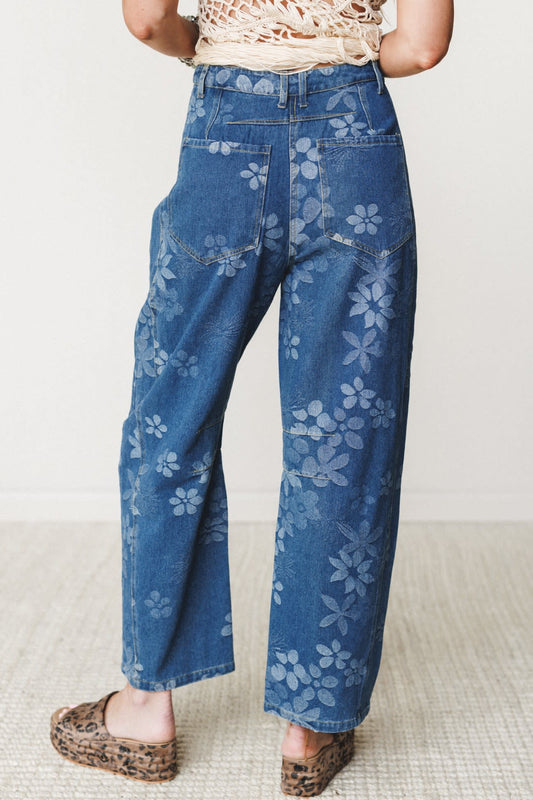
A barrel leg typically curves outwards through the leg before narrowing again towards the ankle. Compared with a traditional straight leg, the shape is intentionally exaggerated.
Can curvy women wear barrel jeans?
Of course.
The more useful question is whether you like the silhouette they create.
Barrel jeans aren't designed to minimise volume. They introduce it deliberately. That curved leg can give an outfit a modern, sculptural feel and create an interesting contrast with a more fitted waist.
If you're new to the style, start with a subtler barrel shape rather than the most exaggerated version you can find. A gently curved leg gives you the character of the cut while remaining relatively easy to style.
Pairing barrel jeans with a more defined upper half can also make the proportions easier to read. A tucked top, fitted T-shirt, cropped knit or structured jacket allows the unusual leg shape to become the focal point.
What Jeans Are Most Flattering for Your Body Shape?
This is where conventional denim advice can become unnecessarily rigid.
Pear shape? Wear this.
Apple shape? Never wear that.
Hourglass? Apparently you have an entirely different denim rulebook.
Body-shape descriptions can be useful as a starting point, but they shouldn't become restrictions. Two people described as having the same body shape can have different heights, torso lengths, thigh proportions, waist-to-hip ratios and personal preferences.
Use body shape to understand proportion — not to decide what you're "allowed" to wear.
Jeans for an hourglass figure
If your waist is noticeably more defined relative to your hips, the biggest challenge may be finding jeans that fit the waist and thighs simultaneously.
A pair that accommodates curvier hips may leave excess room at the waistband. A pair that fits a smaller waist may feel too restrictive lower down.
Look for features such as:
- a contoured or fitted waistband;
- stretch denim with good shape retention;
- room through the hips and thighs;
- a rise that sits comfortably at your natural waist;
- cuts designed to accommodate a greater waist-to-hip ratio.
Straight leg, bootcut, flare, skinny and wide leg jeans can all work on an hourglass figure.
The waistband may ultimately matter more than the leg cut.
Jeans for pear-shaped bodies
If your hips and thighs are proportionally fuller than your upper body, you may want jeans that accommodate that difference comfortably.
Bootcut and flare jeans can help balance proportions because the leg widens again towards the hem. Wide leg jeans can achieve a similar effect with a more continuous line from the hip downwards.
Straight leg jeans are another strong option when you want something between fitted and voluminous.
But don't dismiss skinny or tapered styles.
If you like highlighting your hips and legs, a closer cut can do exactly that. "Flattering" does not require disguising the widest part of your body.
Jeans for an apple-shaped body
If you tend to carry more fullness around your middle, waistband comfort may become the priority.
A mid or high rise can provide additional coverage, while a wider, comfortable waistband can help distribute pressure more evenly. Some people also prefer an elasticated waistband or elasticated back waistband for additional flexibility.
Look carefully at how the jeans behave when you're sitting.
A waistband that feels perfectly comfortable while standing in front of a mirror may feel very different after twenty minutes in a chair.
Straight, bootcut and wide leg styles can all create a long line through the lower body. But again, there is no requirement to use your jeans to "correct" an apple shape.
Choose the leg that gives you the outfit you want.
Jeans for a rectangle body shape
If your waist, hips and shoulders have relatively similar proportions, jeans can be used to create as much — or as little — additional shape as you prefer.
High waisted jeans can emphasise the waist. Mom jeans and barrel jeans can introduce volume around the hips and legs. Flared jeans can create a more dramatic lower-body silhouette, while straight jeans preserve a cleaner vertical line.
The point isn't to manufacture an hourglass figure.
It's to understand that different cuts change the geometry of an outfit.
Once you see jeans that way, shopping becomes much less about rules and much more about choosing the shape you actually want.
The Waist-Gaping Problem: When Jeans Fit Everywhere Except the Waist
Few denim problems are more frustrating.
The jeans slide over your hips. They fit your thighs. The seat looks good.
Then you turn sideways and discover enough space at the back of the waistband to store a small paperback.
Waistband gaping is particularly common when there is a larger difference between the waist and hip measurements. It isn't necessarily a sign that you've chosen the wrong size.
Often, it's a proportion issue.
Sizing down may remove the waistband gap but make the jeans too tight across the hips and thighs. Sizing up obviously won't solve it either.
Instead, look at the construction.
A contoured waistband is shaped rather than cut as a simple straight strip, helping it follow the body's curve from hips towards waist. Stretch can also help, as can denim designed specifically with curvier proportions in mind.
If waist gaping is a recurring problem, prioritise:
- contoured waistbands;
- curve-friendly cuts;
- adequate room through the hips and seat;
- stretch with strong fabric recovery;
- the correct rise for your torso and natural waist.
Alterations are another option. If a pair fits exceptionally well everywhere else, having the waistband adjusted can turn "nearly right" into something much closer to a perfect fit.
Because ultimately, finding flattering plus size jeans isn't about forcing every part of your body into the nearest standard measurement.
It's about finding — or creating — jeans that understand your proportions.
The Best Jeans for Fuller Thighs
If your thighs are usually the deciding factor when buying jeans, start there.
It's tempting to focus on the waistband first, especially when you're trying to find a defined, flattering fit. But jeans that sit beautifully at the waist and pull uncomfortably across the thighs aren't the right fit.
For fuller thighs, look for enough space through the upper leg that you can sit, walk and climb stairs comfortably without excessive pulling.
Some particularly useful cuts include:
- Straight leg jeans, which can provide more room below the thigh than a skinny fit.
- Wide leg jeans, which offer space through the leg while creating a long, flowing silhouette.
- Bootcut jeans, which follow the upper leg before opening gently below the knee.
- Relaxed fit jeans, including boyfriend-inspired cuts, for greater ease through the hips and thighs.
- Stretch denim jeans, when you want a closer silhouette without sacrificing flexibility.
Watch the fabric when you try jeans on.
Strong horizontal creases radiating from the crotch or upper thighs can indicate that the denim is under tension. Pockets pulling open or seams appearing strained are other signs that you may need more room through this area.
And remember: the answer isn't always to size up.
If sizing up fixes the thighs but leaves the waist dramatically oversized, you may simply need a different cut — ideally one with more room through the hips and thighs relative to the waistband.
What about jeans for thick thighs and a smaller waist?
This is where curve-specific proportions can really help.
If you regularly find yourself choosing between a fitted waist and comfortable thighs, look for curvy jeans with a more pronounced waist-to-hip ratio, a contoured waistband or strategically placed stretch.
The goal is straightforward:
fit the thighs without losing the waist.
That can make an enormous difference to both comfort and silhouette.
What About Jeans for a Tummy?
There's a lot of language surrounding "tummy-flattering jeans", and it's worth approaching it carefully.
Your stomach doesn't need hiding.
But you may want jeans that feel supportive, smooth comfortably under clothes or simply don't cut into your middle when you sit down.
Those are practical fit considerations.
For more coverage through the stomach, a high-waisted fit can be worth trying. The waistband sits higher on the torso rather than cutting across a lower point of the stomach, and some people find this considerably more comfortable.
Others prefer mid rise jeans because they sit more naturally on their particular body proportions.
Pay attention to:
- waistband width;
- rise height;
- fabric softness;
- stretch and recovery;
- where the button fastening sits;
- whether the waistband rolls or folds;
- comfort when sitting.
A wide, well-fitting waistband may feel smoother than a narrow one. Stretch fabric can provide flexibility, while more structured denim may offer a firmer sensation.
Neither should feel painful.
The sitting-down test matters. Jeans spend a surprising amount of their lives bent at the hips. If they only feel good while you're standing perfectly upright, they don't really fit your everyday life.
"Tummy smoothing" and "belly support" can be useful descriptions of how a garment feels, but don't let them become requirements. Some people want sculpting jeans. Others want soft denim that barely feels like it's there.
Both are valid definitions of comfortable jeans.
Petite Plus Size Jeans: Length Changes Everything
Finding a good fit through the waist and hips is only part of the equation.
Then there's length.
If you're shorter, standard leg lengths can change the intended shape of a jean considerably. A knee break may sit too low, a flare may begin in the wrong place, or a supposedly ankle-length jean might reach the floor.
That's why the inseam deserves almost as much attention as the waist measurement.
For petite plus size jeans, the ideal length depends partly on the cut.
Straight leg
A clean hem around the ankle or lower can preserve the straight vertical line. Excessive bunching can make the silhouette look different from how the jean was designed.
Wide leg
Length can make or break a wide leg fit.
Too short and the proportions may feel abruptly cut off. Too long and the hem can drag, fold and obscure your footwear.
Bootcut and flare
Here, length is especially important because the widening hem is part of the overall silhouette.
If you're planning to wear flared jeans with heels or platform shoes, try them with a similar heel height before deciding whether the length works.
Cropped jeans
Cropped jeans and ankle jeans can be particularly useful when you deliberately want to expose the ankle or highlight footwear.
Just remember that "cropped" is relative.
A cropped jean on a taller model may become full length on a shorter wearer — which isn't necessarily a problem if you like the result.
The label matters less than where the hem actually lands on you.
How Should Plus Size Jeans Actually Fit?
A size label can point you in the right direction.
It cannot tell you whether the jeans fit.
When trying on plus size denim, assess the garment as a whole rather than concentrating on whether the zip closes.
A good fitting-room routine looks something like this:
- Check the waistband. It should feel secure without painfully digging in.
- Look at the back waist. A significant waistband gap may suggest that the cut doesn't match your waist-to-hip ratio.
- Check the hips and seat. The fabric should follow your shape without severe pulling or excess sagging.
- Look across the thighs. Make sure you have the amount of room appropriate to the intended cut.
- Sit down. This is non-negotiable.
- Walk around. Denim that restricts your stride won't become more convenient once you're outside.
- Bend your knees. Check whether the fabric allows normal movement.
- Look at the side view. This can reveal pulling, pocket placement or waistband issues that aren't obvious from the front.
- Check the hem. Consider the footwear you'll wear with the jeans.
- Stay in them for a few minutes. Some fit problems only become obvious after the initial "they button!" excitement has passed.
Should you size up or size down in jeans?
There isn't a universal answer.
If the jeans are uncomfortable through multiple areas, size up and compare the fit.
If they're loose everywhere and sliding down, size down and compare again.
But if they fit perfectly in one area and badly in another, changing size may not solve the underlying problem.
For example:
- fits thighs, huge at waist = try a curvier cut or contoured waistband;
- fits waist, restrictive at thighs = try a roomier leg or curve fit;
- fits everywhere, too long = look for another inseam;
- fits initially, becomes baggy quickly = investigate fabric recovery;
- waistband constantly rolls = try another rise, waistband construction or fabric;
- crotch hangs too low = the rise or overall cut may be wrong for your proportions.
A different cut is often more useful than a different size.
The Most Flattering Jean Cuts at a Glance
Still deciding where to begin? Use this as a starting point rather than a rulebook.
| Jean cut | Overall effect | Worth trying if you want... |
|---|---|---|
| Straight leg | Clean, streamlined | Versatility and an easy vertical line |
| Wide leg | Fluid, proportion-balancing | Room through the legs and a statement silhouette |
| Bootcut | Gently balanced | A subtle flare that balances hips |
| Flare | Dramatic, leg-lengthening | A defined waist with stronger lower-leg volume |
| Skinny | Close, curve-hugging | To follow and showcase your natural leg shape |
| Mom jean | Relaxed, tapered | More room through hips and thighs |
| Boyfriend jean | Loose, casual | Comfort and a laid-back silhouette |
| Barrel jean | Curved, sculptural | A fashion-forward, deliberately voluminous leg |
| Kick flare | Cropped, subtly flared | A gentler alternative to a full flare |
| Jeggings | Very fitted and flexible | Stretch, softness and a close silhouette |
There's no winner in that table.
That's rather the point.
What Jeans Are Most Flattering for Plus Size Women?
If you're looking for one definitive answer, it might be disappointing to discover that there isn't one.
But that's actually good news.
The best jeans for curvy women aren't restricted to a single cut.
A pear-shaped woman might adore skinny jeans. Someone with an apple shape might live in wide legs. An hourglass figure might prefer boyfriend jeans. A woman with fuller thighs might find that barrel jeans are the pair she never knew she needed.
What tends to matter more is the relationship between several features:
rise + waistband + hip fit + thigh fit + leg shape + fabric + length.
Get those working together and you're much closer to flattering jeans than you would be by following a rule based solely on dress size or body shape.
How to Style Plus Size Jeans Without Overthinking It
Once you've found jeans that fit, styling becomes much easier.
And it doesn't require an elaborate formula.
The simplest approach is to consider proportion and contrast.
If your jeans have lots of volume, you can contrast that with something more fitted above. If your jeans are skinny or tapered, you might enjoy adding volume with a loose shirt, knit or jacket.
Or ignore that contrast entirely and deliberately wear volume with volume.
Personal style is allowed to be interesting.
With straight leg jeans
Straight legs are wonderfully adaptable.
Try a T-shirt and trainers for everyday wear, a blouse and loafers for a smarter look, or add a blazer for an easy smart-casual outfit.
A partial or full tuck can define your waist, but leaving the top untucked can create an equally good, more relaxed silhouette.
With wide leg jeans
Wide leg jeans already create movement, so consider whether you want to emphasise or contrast it.
A fitted top makes the wide leg more pronounced. A flowing shirt creates a softer, more voluminous outfit.
If you're interested in elongating the legs, a higher rise combined with a longer wide leg can create a particularly strong vertical line.
With bootcut and flared jeans
These cuts naturally draw attention towards the lower half of the outfit.
A tucked top can emphasise the contrast between a fitted waist and wider hem. A shorter jacket can have a similar waist-defining effect.
But longer layers work too, especially if you enjoy a softer, more relaxed look.
With skinny jeans
Skinny jeans create a streamlined base that works particularly well with oversized shirts, longline knits, jackets and other looser layers.
They're also useful with boots because there's less fabric around the ankle.
With relaxed jeans
Mom, boyfriend and other slouchy jeans can be dressed up surprisingly easily.
Try combining their casual silhouette with something unexpected: a structured blazer, polished shoe or more refined top.
That high-low contrast often makes a simple denim outfit much more interesting.
Five Denim Myths Worth Leaving Behind
Some plus size styling advice has been repeated for so long that it can start sounding like fact.
It isn't.
1. "Plus size women shouldn't wear skinny jeans"
Wear them if you like them.
Skinny jeans follow the body's shape. That's a design characteristic, not a flaw.
2. "Wide leg jeans make you look bigger"
Wide legs add volume to the garment, but volume isn't automatically unflattering.
A well-cut wide leg can create a beautifully balanced silhouette and strong vertical line.
3. "Dark denim is always more slimming"
Dark denim can create a clean, streamlined appearance, but wash is only one small part of the overall effect.
Cut, fit, rise, seams, pocket placement and styling all contribute to the silhouette.
And you don't have to make "slimming" the objective in the first place.
4. "Curvy women should always define the waist"
Only if you want to.
Defining your waist can create striking proportions, but relaxed, straight and oversized silhouettes can look fantastic too.
5. "If the jeans button, they fit"
Definitely not.
Jeans need to function when you're walking, sitting, bending and living.
A button is not a fit test.
How to Find Jeans That Don't Gap at the Waist
Because this problem is so common, it's worth having a quick checklist ready when shopping.
Look for:
- contoured waistbands rather than very straight waistband construction;
- cuts offering extra room through the hips relative to the waist;
- stretch denim with reliable recovery;
- waistbands that sit close to your body without digging;
- the correct rise for your torso;
- enough room through the thighs so you don't have to size up purely for your legs.
Also check whether the apparent gap is really a waistband issue.
Sometimes a rise that is too long can create excess fabric around the upper section of the jeans. Sometimes sizing is responsible. Sometimes the garment simply wasn't cut for your proportions.
If everything else fits beautifully, tailoring the waistband remains an option.
The perfect pair doesn't necessarily have to emerge from the hanger perfect.
Before You Buy: The 60-Second Jeans Check
When you're deciding between pairs, forget the label for a moment and ask yourself:
- Can I sit comfortably?
- Can I walk normally?
- Does the waistband stay where I want it?
- Is there pulling across my hips or thighs?
- Is there excessive fabric where I don't want it?
- Does the rise feel natural on my torso?
- Is the inseam right for the intended look?
- Does the denim recover after stretching?
- Will these work with shoes and tops I already own?
- Do I like the silhouette?
That last question deserves more weight than it usually gets.
Not:
"Is this supposed to flatter my body shape?"
But:
"Do I like how I look in these?"
Those are very different questions.
The Best Jeans Work With Your Body, Not Against It
Finding flattering plus size jeans becomes much simpler once you stop searching for the single cut that curvy women are supposedly meant to wear.
There isn't one.
There are straight legs that skim. Wide legs that sweep. Bootcuts that gently balance the hips. Flares that turn denim into a statement. Skinny jeans that hug every curve. Mom jeans with room through the thighs. Boyfriend cuts that deliberately relax the silhouette. Barrel legs that play with shape rather than trying to minimise it.
Then there are the details you don't necessarily notice from across the room but certainly notice after several hours of wear: a comfortable waistband, the right rise, enough hip and thigh room, good fabric recovery and an inseam that works with your height.
Those details are often where the real difference between "these jeans fit" and "I love these jeans" can be found.
So use body-shape advice as information, not instruction.
Experiment with cuts you haven't tried before. Compare high rise with mid rise. Try structured denim next to soft stretch denim. Put on the wide legs you once assumed weren't for you. Revisit the flare. Keep your skinny jeans if you still love them.
And don't be afraid to reject a pair simply because it doesn't feel right — even if someone insists that particular style is the "most flattering" for your shape.
Real bodies aren't standardised.
Your jeans don't have to pretend they are.
The most flattering cut is ultimately the one that gives you the combination of comfort, proportion, movement and style that makes you want to keep wearing it.
Frequently Asked Questions About Plus Size Jeans
1. Should plus size jeans feel tight when you first try them on?
It depends on the denim. Stretch denim can feel comfortably close when new because the fabric will usually relax slightly with wear, but it shouldn't pinch, restrict movement or make sitting uncomfortable. Rigid denim may feel firmer initially, although it should still allow normal movement.
Don't buy painfully tight jeans on the assumption that they'll eventually become the perfect fit. A close fit is fine; discomfort is a sign to try another size, cut or fabric.
2. Which jean pockets are most flattering on a curvy figure?
Back-pocket placement can noticeably change the appearance of jeans. Pockets positioned relatively centrally on the seat can create a balanced look, while very small, widely spaced or unusually low pockets may produce a different visual effect.
Pocket size matters too. Proportionate pockets often complement curvier figures particularly well, but there is no universally "correct" placement. Check the jeans from behind and choose the design that creates the silhouette you prefer.
3. Are light-wash jeans flattering on plus size bodies?
Absolutely. Plus size women do not need to restrict themselves to dark denim.
Light blue, mid-wash, stonewashed, grey, black, white and coloured denim can all look fantastic on curvy figures. A darker wash may create a more uniform visual line, while lighter washes can highlight the jean's shape and give an outfit a softer, more casual feel.
Fit and proportion generally have a much greater impact than whether your denim is light or dark.
4. Do cropped jeans make your legs look shorter?
They can alter the perceived proportions of the leg, but that doesn't mean plus size or petite women should avoid them.
Where the hem finishes makes the biggest difference. An ankle jean that exposes a little skin can create a very different line from a wider cropped jean finishing around the lower calf. Footwear also changes the effect.
If creating a leg-lengthening silhouette is important to you, experiment with hem position, rise and shoe choice rather than automatically ruling out cropped jeans.
5. Are jeans with an elasticated waist good for plus size women?
They can be an excellent choice when comfort and flexibility are priorities.
An elasticated waistband or elasticated back waistband can adapt more readily to movement and natural fluctuations around the waist. Pull-on jeans and jeggings can offer similar flexibility.
However, elastic doesn't automatically guarantee a good fit. The jeans should still fit properly through the hips, seat, thighs and legs, and the waistband should remain secure without rolling or digging in.
6. How many pairs of jeans does a plus size wardrobe need?
There is no ideal number, but versatility matters more than quantity.
For many wardrobes, two or three genuinely useful pairs can cover a surprising amount of ground. You might choose a straight leg for everyday outfits, a wide leg or flare for a more distinctive silhouette, and a darker or more structured pair for smarter occasions.
If you wear denim frequently, adding different washes, rises and leg shapes can create considerably more outfit variety without requiring a huge collection.
The better question is: how many pairs do you actually enjoy wearing?
7. Can plus size women wear distressed or ripped jeans?
Yes. Distressing is a design choice, not something determined by body size.
Ripped knees, raw hems, faded sections and distressed details can add texture and personality to denim. If you're concerned about distressed areas pulling across fuller thighs, check their placement while both standing and sitting. Heavily distressed fabric may behave differently from intact denim in areas under greater tension.
Choose the level of distressing that suits your personal style rather than treating it as a body-shape rule.
8. What shoes look best with different plus size jean cuts?
The jean's hem shape and length are generally more important than body size when choosing shoes.
Straight leg and ankle jeans work with everything from trainers and loafers to boots and heels. Wide leg jeans can pair beautifully with platforms, trainers, boots or heels depending on their length. Bootcut and flared jeans often work particularly well when the hem falls neatly over the footwear, while skinny jeans make it easy to wear ankle or knee-high boots.
Rather than searching for special shoes for plus size jeans, consider how the footwear interacts with the jean's leg opening and hem.
9. How often should you wash jeans to help them keep their shape?
Jeans generally don't need washing after every wear unless they're dirty or need refreshing. Less frequent washing can help preserve the fabric, colour and shape for longer.
Always follow the garment's individual care instructions. Washing requirements can differ considerably between stretch denim, rigid denim and embellished or specially finished jeans.
Stretch jeans deserve particular care because excessive heat can affect elastic fibres over time. Following the care label and avoiding unnecessary washing can help maintain fabric recovery and shape retention.
10. What should you wear under fitted plus size jeans for a smoother look?
Start with whatever underwear feels comfortable.
If you want a smoother appearance beneath curve-hugging jeans, seamless underwear can reduce visible lines. The correct underwear size is important too: elastic that digs into the body can create lines that wouldn't otherwise be there.
Shapewear is optional, not a requirement for wearing fitted jeans. Well-fitting denim should provide the silhouette and support built into its design without requiring you to reshape your body underneath it.
Ultimately, flattering plus size jeans should work with the body you're dressing — not depend on hiding it.